
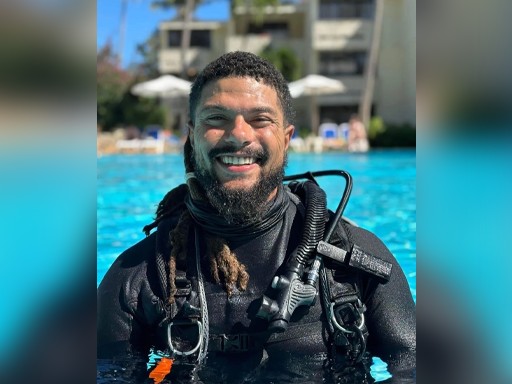
Kory Lamberts’s (‘21, Environmental Studies) path to marine conservation didn’t begin in the ocean. It began in Martinez, California, where he grew up near an oil refinery and, long before he had the language for it, noticed patterns that would later define his work on expanding access to marine environments.
As a child, he saw that his elementary school—attended largely by Latinx, Black, and special needs students—sat closest to industrial pollution.
“At the time, I didn’t have the verbiage,” Lamberts says, “But now I know I was witnessing environmental injustice and environmental racism.”
That early awareness stayed with him, even as his life took several turns before college.
After high school, Lamberts played football and earned a scholarship that took him as far as Tennessee. But when he recognized the campus’s racist culture and symbolism, his spirit compelled him to return to California. He spent the next few years working, traveling, and navigating major life decisions before eventually finding his way to Humboldt County through agricultural work. Humboldt, he says, “offered something he needed at that moment: distance, slowness, and a reset.”
When he returned to school as a 26-year-old transfer student, enrolling in Environmental Studies at the University, it marked the first time he was able to be “a student for fun,” learning not for a job or a title, but for understanding.
At Humboldt, coursework helped him connect his lived experiences to broader systems of power. Classes like Power, Privilege, and Environment gave him a framework to make sense of what he had been noticing his entire life.
“I had this lightbulb moment,” Lambert says. “I just learned the answers to a bunch of things that didn’t make sense growing up.”
Environmental Studies, for Lamberts, became inseparable from social justice. “Every environmental injustice is inherently a social justice crisis,” he says. That perspective shaped both his academic work and his future career.
Outside the classroom, Lamberts found community and purpose through the University’s Project Rebound, a statewide program supporting formerly incarcerated students. As a communications and program coordinator for the program, he worked directly with people returning home after decades in prison—writing letters to incarcerated students, helping them plan for college, and even driving to Pelican Bay State Prison to support individuals' transition back into society.
When he graduated in 2021, he didn’t walk with the general commencement. Instead, he graduated alongside Project Rebound students, some of whom had served more than 20 years in prison. “That’s who I got to graduate with,” Lambert says. “That’s why I go to school. That’s radical education.”
Lamberts was also active in the Umoja Center and in the mycology club. These communities grounded him during his time at Humboldt and reinforced his belief that education should be connected to real people and real outcomes.
That philosophy followed him into the water. While completing Cal Poly Humboldt’s nationally recognized scientific diving program, Lamberts noticed something that felt all too familiar: the absence of Black and brown students in marine science spaces. Later, while working in diversity programming in higher education across multiple universities, he saw how often inclusion efforts stopped at rhetoric rather than at real access. That realization pushed him to build something new.
In 2024, Lamberts founded the Aquatic Futures Foundation, a nonprofit dedicated to the future of the oceans and world by creating pathways into marine conservation for people from historically excluded communities. The organization focuses on connecting students with mentors, building ocean confidence, and providing scuba and scientific diving training that leads to meaningful careers.
“We want to get people comfortable with the ocean,” he says, “with the hope of building people who want to protect it.”
Aquatic Futures operates through a progression of programs, beginning with its Ocean Comfort Course, which helps participants overcome fear and unfamiliarity with the ocean, and extending through advanced scuba certifications and workforce placement in marine science fields. Upon completion, students gain an American Academy of Underwater Sciences (AAUS) certification, allowing them to instantly begin working in the field!
Looking back, Lamberts credits Humboldt with giving him the space to learn deeply and define his own values as an environmentalist. He encourages prospective students to lean into that same opportunity.
“Humboldt,” Lamberts says, “is a place where you can slow down, immerse yourself fully in learning, and let the surrounding landscape support serious reflection and growth.”
Today, through Aquatic Futures Foundation, Lamberts is building the kind of future he once sought, one where access to the ocean, education, and meaningful work is shaped by equity, mentorship, and care. It’s a continuation of lessons first sharpened among the redwoods and the coast, where learning was never just about the environment, but about people, too.