
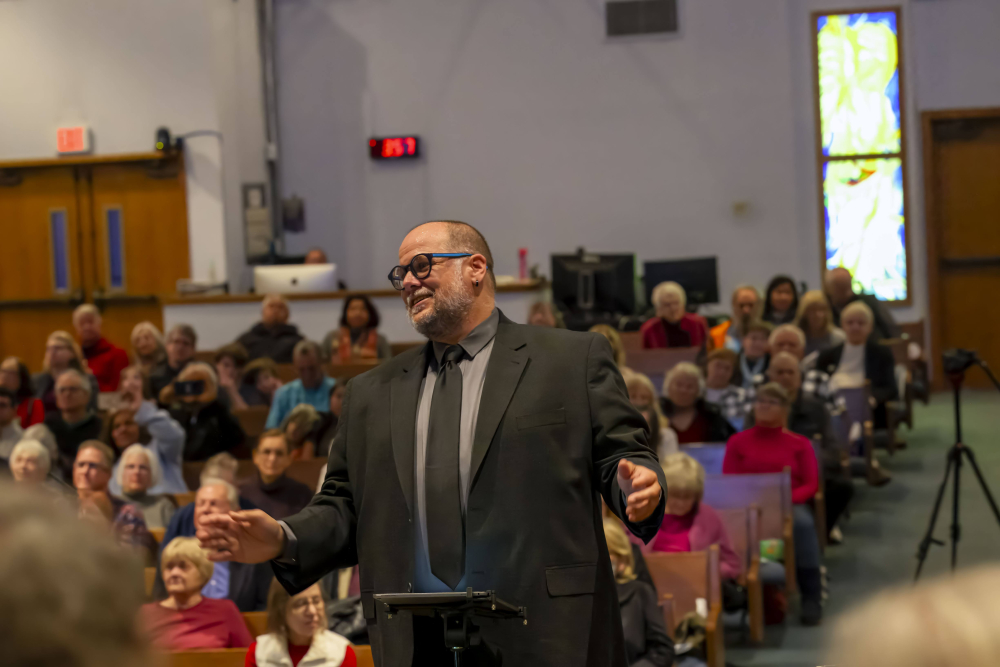
On April 1, when Jonathan Souza (‘01, Music Education) steps onto the podium at Carnegie Hall, he will carry more than a baton in his hand. He will carry a lifetime of rehearsals in small-town band rooms, late nights in the music lobby at Cal Poly Humboldt, the steady encouragement of mentors, and the voices of generations of students who learned to believe in themselves because he first believed in them.
Carnegie Hall—arguably the world’s most iconic concert venue—has stood in New York City since 1891, welcoming legends from Tchaikovsky to The Beatles. For musicians, it represents the pinnacle of artistic achievement. For Souza, serving as guest conductor with MidAmerica Productions is a milestone nearly three decades in the making.
“I’d be lying if I didn’t say I’m nervous,” he says with a laugh. “I don’t know if I’ll ever have this opportunity again. So I wanted to extend this opportunity to as many people as possible in my sphere of influence.”

Jon Souza
That sphere stretches wide.
The program will open with Aaron Copland’s Fanfare for the Common Man and will feature Ralph Vaughan Williams’s Serenade to Music and John Rutter’s Gloria, performed by a combined ensemble of Gilroy High School students, community singers, alumni from across Souza’s 28-year career, and members of his own family. His daughter Cecilia, a Cal Poly Humboldt senior graduating with a degree in Zoology this spring, will sing. So will his son, Nigel, an Electrical Engineering major at San Jose State. His mother, Elizabeth, a lifelong musician, will lend her voice. Even his father, Raymond Souza—the longtime Fortuna High School band and choir director who first placed a trumpet in Souza’s hands—will take part.
“It’s going to be a cross-generational collaboration,” Souza says. “People I’ve touched in my real-life world. Markers along my whole career.”
Music was never a distant dream for Souza. It was the air he breathed.
He grew up in Humboldt County, the son of two musicians. “I’ve been singing all my life,” he says. “My parents sang to me. There was music in the house all the time.”
He spent his childhood in rehearsal rooms, absorbing everything from symphonic band and jazz to choral works and solo repertoire. By high school at Fortuna High, he was an accomplished trumpet player, even earning All-League honors in football. For a time, he considered sports medicine.
But Cal Poly Humboldt offered him scholarships as a music major, and the decision became clear.
“My world got bigger going to Humboldt,” he says. “I met really different people from me. And the music department—you form fast friendships.”
Souza immersed himself in everything: choir, wind ensemble, trumpet lessons, voice study. He stayed five years, pursuing music education while building extensive performance experience in both vocal and instrumental worlds. In a larger institution, that range might have been impossible. At Humboldt, it was encouraged.
“I could play trumpet and be in the choir. That wasn’t an issue,” he says. “The fact that Humboldt really encourages young musicians to have a wide range of experiences is pretty awesome.”
The heart of his college experience, though, wasn’t just the performances. It was the people.
There was the music lobby—chairs pulled together between classes, students debriefing rehearsals, and debating life. There was the safety to experiment and grow. There was falling in love with Christina Souza (‘01, Psychology), a fellow singer who would become his wife and lifelong partner in music and education.
And there were the mentors.
Music Professor James Stanard, his voice teacher, shaped him as a soloist and helped him understand his voice as an instrument. Music Professor Harley Muilenburg introduced him to conducting and “really believed in me,” Souza recalls. “He trusted me. He put me in front of a choir for the first time.”
Professors like Cindy Moyer, Gil Cline, Ken Ayoob, and the late Ken Hannaford built Souza’s theoretical, instrumental, and ensemble foundations.
More than technical skill, they gave him something else.
“They really lift you up and support you and challenge you,” Souza says. “When we’re developing young professionals, it’s not just about fundamental skills. It’s about building the confidence to take risks and move your career forward.”
That confidence proved essential.
After earning his bachelor’s degree, Souza pursued a master’s in choral conducting at San Jose State University, where he was mentored by acclaimed choral conductor Dr. Charlene Archibeque. His career began under an emergency credential in the San Jose area, then took him to Santa Cruz, back to Fortuna High School, and eventually abroad.
In 2005, five years after his father moved on from Fortuna High School , Souza returned to Fortuna High as music director. He led choirs, concert band, and marching band, and introduced a digital recording and music technology class—giving students employable skills alongside artistic training. He received the Wells Fargo Stagecoach Outstanding Teacher Award for Humboldt and Del Norte counties and was named the California Association of Music Education’s Outstanding Music Educator for the North Coast section.
But growth often requires risk.
When an opportunity arose to move to Puerto Vallarta, Mexico, Souza and his wife made a bold choice. With their children still young, they relocated so their family could live internationally and learn Spanish. At the American School of Puerto Vallarta, he taught general music, built choirs, and worked with students from diverse cultural backgrounds.
Eventually, the family returned to California, where Souza now directs choirs at Gilroy High School and leads the South Bay Singers. Over time, he learned to find his own authentic leadership style.
“Early in my career, I was trying to be my dad a little bit,” he reflects. “He’s an award-winning music educator. But there were things that were inauthentic to me. I had to learn how to be myself.”
Today, that authenticity is evident in the programs he builds—from AP Music Theory to a newly launched mariachi ensemble, he cheerfully admits he’s “learning alongside” his students.
As a conductor, he sees his role as an extension of teaching. “Just as my voice is my instrument,” he says, “conducting is my tool in an ensemble setting.” It’s a craft he has studied, practiced, and refined for decades.
He received a Carnegie Hall invitation through his professional network from colleagues who recommended him. Each year, he gets offers to conduct ensembles, but this time he was invited as a guest conductor, and he invited others to join. Thirty-eight students from Gilroy will participate, along with community members, alumni from Fortuna High, and former classmates. This ensemble is a living timeline of Souza’s career.
And woven into that timeline is Humboldt.
“Humboldt’s a really important part of my story,” he says. Now it’s part of his daughter’s story, too. Cecilia chose Cal Poly Humboldt for its smaller campus community and strong support system. Like her dad, she found her place.
On the Carnegie Hall stage, as the first notes of Serenade to Music rise into the famed acoustics, Souza will stand at the center of something far larger than a single performance. He will be conducting teachers and students, parents and peers, past and present. He will be leading with the confidence first nurtured in a rural county on California’s North Coast.
For nearly 30 years, Souza has built communities through music, classrooms where students finally “get it,” marching bands stepping down Main Street USA at Disneyland, and choirs discovering the power of harmony.
“Teaching music was just the right fit for my family and me,” he says. “I love doing it.”
At Carnegie Hall, the applause will honor a guest conductor. But behind that moment stands a Humboldt alum rooted in community, shaped by mentorship, and still learning, still growing, still lifting others into the music.
Editor's Note: The story has been updated to correct the spelling of Gil Cline's name.